A new tree feels like an investment in the future – and it is. But most trees that fail don’t fail because of bad luck or bad weather. They fail because of decisions made in the first hour of planting.
Here are five mistakes that consistently undermine healthy establishment, and what to do instead.
Burying the root flare
The root flare is where the trunk widens and meets the roots at the base of the tree. It is ideally located at the soil grade. If it’s buried just a few inches underground, the bark in that area remains moist, eventually decaying, and the roots are deprived of oxygen.
Improper planting depth and unhealthy root systems can stop your tree from ever making it past the first few months. Trees that have been planted too deep don’t necessarily die right away; rather, they slowly deteriorate over time. By the time you notice the tree declining, it’s too late to save it.
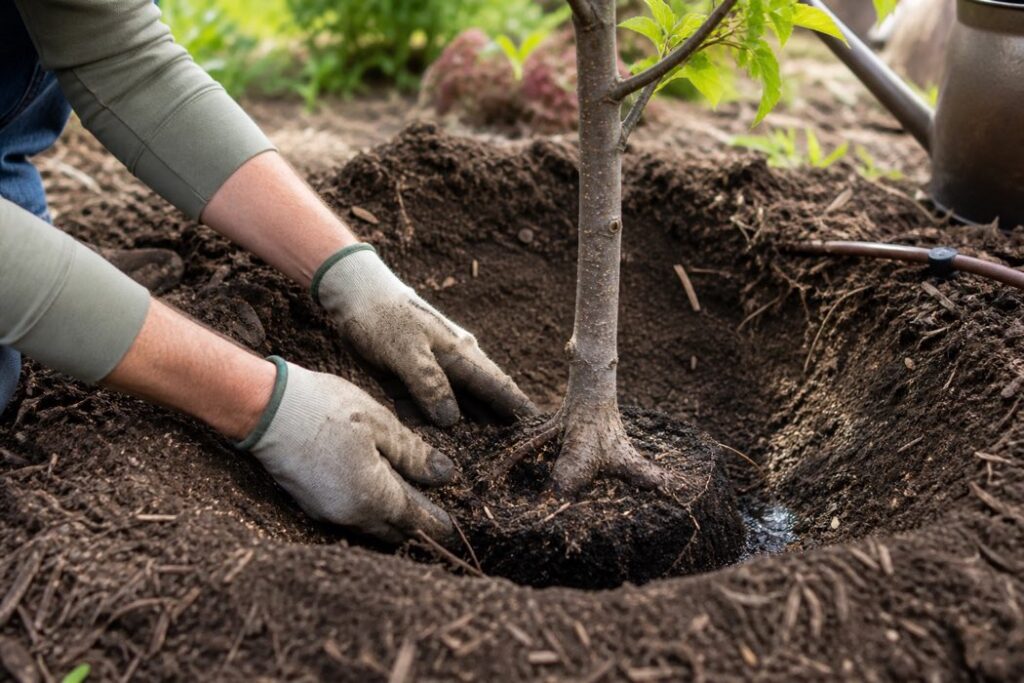
Locate the root flare on the tree you intend to plant before you start digging. Often, the root flare is covered with excess nursery soil. Do not skip the step of removing this soil and using the root flare as a guide to determine the depth of the planting hole.
Digging a deep, narrow hole in clay soil
Heavy clay soil doesn’t drain. When you dig a deep, narrow hole in it, you create something close to a bathtub. Water pools at the bottom, saturates the root ball, and the roots effectively drown.
The fix is straightforward: dig wide, not deep. The hole should be two to three times the diameter of the root ball but no deeper than it. Roughen the sides of the hole with a spade so roots aren’t hitting a smooth compacted wall that redirects them in circles. Good soil contact around a wide planting area helps roots establish outward, which is the direction you want them to go.
If you’re unsure how your soil drains or which species is suited to your block, talking to experienced local arborists like GTS Trees before you buy the tree can save a lot of grief later.
Leaving synthetic materials on the root ball
The burlap will disintegrate in a few years. If it’s synthetic burlap, you need to remove it all. Girdling roots may not become evident in a newly planted tree for three to seven years, but when they do tree decline can be swift.
Getting staking wrong
Using stakes for trees may seem like a good idea to protect them, but the truth is that if done inappropriately, it can do more damage than good. If a tree is staked too firmly, it does not have the chance to move with the wind. This movement helps the roots to grow and the trunk to become stronger.
If a tree doesn’t have the chance to move, it will not develop its strength to stand on its own. And when the stakes are finally removed, likely years too late, the tree is at risk.
Stake a tree only if it absolutely cannot stand on its own. Or, if the area is extremely windy. If you do decide to stake the tree, make sure to use two flexible ties. Position these ties low on the trunk of the tree and remove them after one year. The purpose of staking a tree should only be to provide temporary stability.
Watering incorrectly after planting
Providing daily light watering might seem like a caring attitude but it doesn’t do your tree any good. The water is too shallow and simply wets the soil surface while the root ball – several inches below grade – stays dry. Your tree is in transplant shock. Ironically, that shallow water can make it easier for the roots to migrate upward rather than down and outward.
Newly planted trees need deep, infrequent watering. Soak the root zone and allow it to dry slightly before watering again. A slow trickle at the base for 30 to 45 minutes, two to three times per week during the first growing season will do the trick.
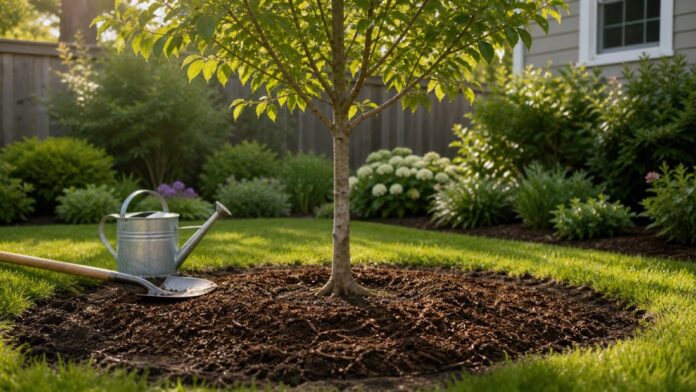
Finally apply a 75mm layer of mulch, spread out widely around the base and away from the trunk to retain moisture and moderate soil temperature.
Whatever you do, don’t pile mulch up against the bark. Volcano mulching traps moisture against the trunk and leads to rot and pests. Keep the root flare visible and the mulch flat.
The biology of a tree does not forgive hasty planting practices. A few simple and informed decisions on day one, like the right depth, the right hole, and correct watering, and the tree is likely good for decades.