The case against heating your whole house when you’re sitting in one room
For most folks, air conditioning isn’t a part of their long-term financial planning. It’s something they notice during the sweltering months. That said, the “dumb” way we’ve been air conditioning for years (thermostat in one location, one temperature, whole home) wastes around 30% of the energy we pay for.
The technology to do things differently has been around long enough that we should be super embarrassed by it.
The “Average Temperature” Problem
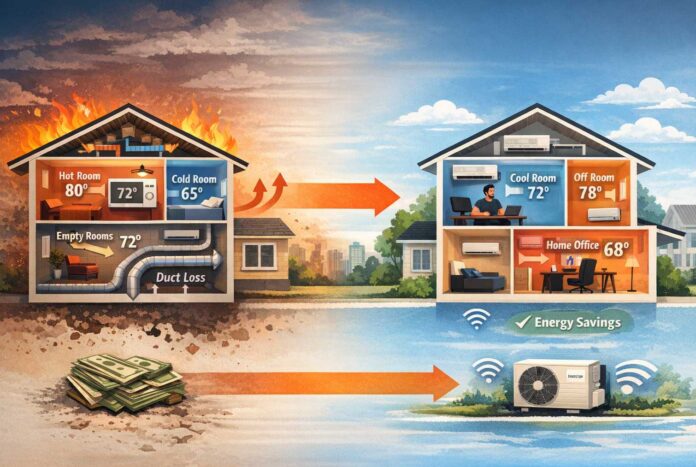
Central ducted systems are a compromise. The thermostat is in the center and is trying to reach a goal that doesn’t represent what is going on in rooms all over the building. The north bedroom runs cold because the thermostat is in the southwest corner while the west bedroom bakes all afternoon from the sun.
That west room has a completely different heat load (how much the building heats up) than a shaded room on the other side of the building.
If there’s only one system to account for the room that can get the hottest, the system runs colder to make up for it. You pay for that cold system all summer long, not just when that room is hot.
Building orientation has always been accepted as changing how rooms act and react with temperature. Our approach to HVAC has mostly ignored this.
Duct Loss is a Hidden Tax on Every Cooling Cycle
Traditional ducted systems have a flaw in their design that we don’t think gets enough attention. When cooled air is forced through ducts, especially ducts that snake through uncooled areas such as attics, that air gets warmer before it ever has a chance to cool you down.
The U.S. Department of Energy says duct losses can account for more than 30% of energy consumption for space conditioning.
That is not a small inefficiency. That’s a full third of your bill being used to cool air that heats up before it can help you. Room-specific ductless systems sidestep this problem entirely. There are no ducts to lose.
The Hardware That Actually Enables Room Control
Knowing why zoning works is helpful, but having the gear to make it work for you matters more to the average consumer.
A split system air conditioning unit operates independently in a single room, one unit inside, one compressor outside, with no need to push air through the rest of the house. You condition the room you’re using. Nothing running everywhere else.
Multiple splits build on that with several indoor units connecting to a shared outside compressor, and separate controls for each of them. One bedroom, one living space, and one home office can each be different temperatures at once, or none if empty.
These days, the best of these systems use inverter technology: compressors of variable speed, which modulate output rather than switch on and off. Classic systems start, blow at full speed, reach the temperature and turn off. Rinse and repeat.
Start-up burns more power and temperatures get bigger. The inverter maintains a consistent temperature by running at low speed continuously, which is more effective and more cozy.
Occupancy and Automation Close the Loop
Another element is control logic. No matter how good the hardware, you pour energy down the drain if you’re heating or cooling areas when you don’t need to be.
This used to be purely something you had to remember to do, or rely on things like sunrooms that got too warm as “free” passive heating for the rest of the house (or shades as passive cooling). But for the past decade, smart thermostats and occupancy sensors have made this essentially automatic and invisible to you.
They just see you come in; they turn everything on and give you a pleasant background; then they see you leaving and turn that area down.
WiFi-enabled controls enhance this further, allowing to add geofencing. This lets the system look at your phone’s location, and start heating or cooling your house when you’re close to home so it’s the right temperature when you arrive, without having to run heating or cooling all day while you’re out.
Sizing Still Matters
All of this becomes ineffective if the units are not appropriately scaled. The BTU ratings determine the amount of heat that a unit can take out of a space, and it should correspond to the specific volume and heat load of each room.
If a unit is too powerful, it will turn on and off too frequently, reducing dehumidification and overall efficiency. If a unit is too weak, it will run nonstop and never reach the desired temperature.
In order for the room-by-room method to be cost-effective, it’s necessary for each unit to correspond to a specific room. In most cases, this requires taking into consideration the window size, insulation, ceiling height, and overall orientation of the room, not just the square footage.
Getting the System Right From the Start
Having control over the temperature in each room works effectively as it eliminates the concept of treating a home as one unit in terms of thermal energy. Indeed, each room has different conditions, usage in terms of occupancy, and load.
The real savings are made by adjusting the system to these specificities rather than taking an overall average.
This type of technology is well developed, easily accessible, and the costs saved from installation will eventually cover the investment. The real question is not if you should adopt this new system, rather how long you will wait before doing so.